
Night of the Silver Pull
Under a swollen moon, two men with secrets circle each other until instinct overrides caution.
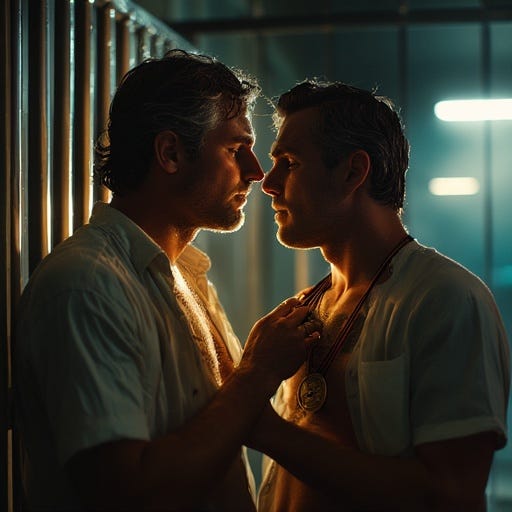
Silver Rituals, Shadowed Hearts
I never believed in omens until I met him, but the air that night, thick with electricity and every unsaid thing, made the city’s edges glisten, raw as a nerve. Silver Hill Hospital always looked its most secret by moonlight: arches gone skeletal, brickwork sweating under the watching gaze of a swollen June moon. In the ambulance bay, bleached concrete glowed ghostly; the world was nothing but shadow and the low hum of city survival. As I stood there, the unsettling itch of yearning that I had masked as routine began to surface, connecting me to the night in a way I hadn’t felt before. I rubbed my thumb against the coin in my pocket—a Saint Sebastian medal, scuffed by years, gifted by a dying patient who claimed it made invisible wounds seen. Everyone in Silver Hill had their own ritual talisman.
He was already there, lingering half in the amber spill of the streetlamp, half in the lunar stark. Shaan. ER charge nurse, jawline cut straight from a story older than most of us dare admit, dark eyes keen, always searching for one more pulse, one more truth. If I squinted, the twist of his shoulder looked tense, not just tired. It’s never just fatigue in medicine—it’s the weight of other people’s breaking points, wedged into your bones by the shift’s end.
I came for air, the lie I tell myself when I’m lost. He watched, silent, measuring. A pulse of heat across my shoulders—his regard, not the night—made breathing feel earned. We’d had our skirmishes before: in supply rooms, over clipped charting, through the broken grammar of midnight codes. There was a legend among the night staff—after three full moons survived together, the hospital’s shadows would offer a secret, if you dared meet them with open eyes.
Tonight marked our third full moon. I caught Shaan glancing at my pocket, the outline of the medal a promise or a threat. His hand brushed the radio at his hip, then lingered on the fabric of his scrub top, tracing the barely visible outline of a tattoo: a battered compass rose, with a blood-red North and the initials S.P.H. stitched through the center. Silver Pull Hospital—our home, our trap. Legend said if you bled at the crossroads, your secrets marked you, and the place would never let you go. Sometimes, you held on anyway.
“Long night, Wilder?” Shaan’s voice rolled deep, a velvet rasp. Normally, I’d deflect—banter, bite, battle—but the moon seemed to thin my armor. Instead, I twisted the medal between my fingers, letting the weight of ritual settle me.
“Longest.” My mouth went dry. “Wasn’t sure if you’d be here.”
He stepped closer, work-weary but hungry, eyes both challenge and question. A breeze caught the edge of his collar, exposing a fresh scratch: jagged, angry. The kind you get wresting pain from someone else’s grip, or maybe from saving yourself. I resisted the urge to ask, knowing it’d be a boundary crossed too soon. Boundaries mattered at Silver Hill—they were the only thing standing between intimacy and self-destruction.
“You always come out here when you need a minute. Even when you say you don’t.”
His words ghosted over my skin. Ritual, observation, confession. I remembered the first time I’d watched him thread an IV in the chaos of a trauma surge: hands steady, voice tight, but eyes soft, as if promising the unconscious patient that survival was still possible. I envied and resented that steadiness, the way he seemed to hold the whole world in check, just by breathing.
Now, the only thing holding me steady was the humming coin in my pocket, and the storm of his attention. There was something almost sacred about how we circled each other, suspicion and longing tangled. Silver Hill folklore said the moon revealed what daylight hid. I wondered what it’d pull from us tonight.
He leaned on the barrier beside me, careful not to bridge the gap but close enough for his scent—clean sweat, bergamot, adrenaline burn—to tumble me back into my body. I felt myself falling toward the ache of what I hadn’t yet risked.
“You ever think about leaving?” I asked—quiet, truth-thin. It slipped out before I could layer on leaf or armor. My voice sounded too much like a plea.
Shaan’s silence felt heavy, like a decision hanging in the air. I heard the pulse in my neck, wild and insistent. He turned, knuckles white against the metal railing, and I wondered if anyone else could see the longing mapped in that tension. Our secrets performed for the night staff—witnesses unseen, yet close as communion. Shadows flickered in the emergency bay, gossip drifting with the cigarette haze from the security hut.
His voice returned, quiet and thoughtful, as if remembering. "Not in a long time," he exhaled, shoulders easing but not quite surrendering. "Nowhere to go that knows me. Here, at least, I'm known." There was a time a few years ago, before the third night shift in a row, when I had seen him sitting alone in the breakroom, eyes lost to the formica table, invisible amidst the bustle of rushing staff. I remembered how he'd looked up at me–brief, unguarded—and then back down again, as if retreating into himself. Tonight, we stood different, presence acknowledged by moonlight and shared shadow.
I almost spoke. Almost bared everything: my mother’s hospital charts boxed beside my bed at home, each brittle page a ledger of the ways care can fail you. The ache of losing her—not to illness, not really, but to the silence it imposed. I wanted to lay that wound between us, let him see the map of my fear. I didn’t. I just thumbed the medal, a benediction for the cowardly.
I caught his gaze again. It burned. “Tell me your rule, Shaan.”
He hesitated, tongue working against his teeth, as if debating whether I’d earned this piece of him. "Never bring the night back inside. What happens out here, under this sky, it stays." The weight of his words settled between us, and I felt the boundaries being set like a gentle shield against vulnerability. What rule keeps your own softness intact? The question lingered in the air, inviting reflection, mirroring the courage it takes to share such a personal credo. It drew us deeper into the shared ritual, offering a glimpse into the walls we build and the ones we're willing to tear down.
I recognized the need behind it: a rule designed to preserve something soft, secret, essential. The community at Silver Hill always gossiped about the rituals of the night staff—cigarette offerings, the draping of hospital IDs over the hawthorn bush, the medal for wounds unspoken. Even how we navigated touch: elbow brushes, hands never lingering too long unless permission was granted. Legend said aftercare mattered more than climax, that bonds survived by quiet promises, not declarations. I nodded, accepting his rule, even as my hands itched to break it. To underscore how vital aftercare was, some of us practiced a token exchange after moments of kindling sparks. Something as simple as a text message the next day, affirming 'I'm here,' or leaving breakfast on the counter if the shift allowed it. These actions were gentle reminders that care continued beyond the intensity of nighttime confessions.
“Then we leave the moon out here too.”
A shy smile—real, brittle, precious. One foot in uncertainty, the other daring a step. I felt the air thicken with a new promise: this night would rewrite the story I told myself about pain and connection. A hook buried gently under my ribs.
Shaan’s eyes flicked down to my pocket. “You carry her with you?”
Her. The medal. My mother, my losses, the way this place cuts and stitches us together with shared grief. I nodded, pulse skipping.
“Only way I know how to come home,” I whispered.
He reached into his scrubs, pulling out his own anchor—a battered folding card, edges worn, the call codes for cardiac arrest and rapid response handwritten in Bengali and English. A makeshift ledger for emergencies; another language for survival. “Mine too,” he admitted, voice steady but raw.
We watched each other, hands full of tokens: memory and legacy marking us as survivors, hopefuls, men who’d earned their secrets the hard way. A ritual older than either of us, and twice as hungry.
A door slammed behind us—security shift change. The world snapped tight, the spell fraying. Staff faces at a distant window, a flash of knowing, curious, unfazed. Witnesses, because in medicine everything gets recorded—even the ache, even the possibility.
“Do we make a promise for next time?” Shaan asked, voice pitched low, threading laughter and longing, daring me to say yes.
I hesitated—then nodded. “Next full moon. But only if you bring the card.”
He grinned, promise flaring in the dark, a new ritual born. “Deal. Only if you show me the coin.”
We stood suspended, two men outlined by hospital legend and silver moon glare, the city’s breath tight around us. I let myself imagine the future: a shared ritual, a secret held between bones and badge clip, and the risk of being more than rumor, more than survivors. The ache of that promise sent heat pooling low in my belly—not lust yet, but the build-up, the only start that ever means something.
The moon climbed higher, a wedge of silver peeling the night apart. What would we lose, what might be remade, by daring to meet each other in that glare? I felt the old ache turn sharp and gold inside me, legend and longing braided tight. It was only the beginning, and everything I’d ever been afraid to hope for was breathing with me in the dark.

Unlock the full story—subscribe for exclusive access to Grant’s most intimate, confessional fiction and every Moonbound secret.
